Posts

Showing posts with the label cnc diamond inserts

VNGA 332 VNGA160408 CNC Brazed PCD Inserts

Image
VNGA 332 VNGA160408 CNC Brazed PCD Inserts Contact Us Via  pcdmetaltools@gmail.com Brand Slugger PCD_Brand E6 ANSI VNGA 332 ISO VNGA160408 Coated No Usage CNC Turning Tool,Milling Tools,Thread Tools Cutting_Edge 1 Cutting_Edge_Length 16,61 Thickness 4,76 mm Corner_Radius 0.8

Something you should know for CNC PCD Tipped Inserts

Image
Edge Hone: The edge hone is by far the most commonly used edge preparation. Many inserts are automatically provided with an edge hone at the time of purchase, especially larger inserts that will be exposed to heavy cutting. An edge hone on a ground or precision insert must usually be specially requested. It is standard practice of all manufacturers to hone inserts that are to be coated before the inserts are subjected to the coating process. The reason for this is that during the coating process, the coating material tends to build up on sharp edges. Therefore, it is necessary to hone those edges to prevent build-up. "L" Land: The "L" land edge preparation adds strength to the cutting edge of an insert. Essentially, the "L" land amplifies the advantages of negative rake by diverting a greater amount of cutting force into the body of the insert. An "L" land is normally used only on negative, flat top inserts placed at a negative rake angle. T...

CNC Diamond PCD and CBN Turning Inserts

Image
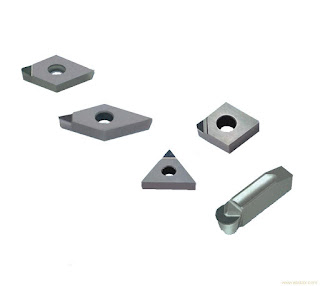
                     CNC Diamond PCD and CBN Turning Inserts PCD is formed in a large High Temperature-High Pressure (HT-HP) press, as either a diamond wafer on a backing of carbide, or forming a "vein" of diamond within a carbide wafer or rod. PCD is no good for cutting steels for similar reasons, except substitute carbon (what diamond is made from) for nickel. That's why diamond is pretty much exclusively used for non-ferrous/fiberglass/composite materials. Oddly, it is still able to be used and recommended to cut carbon fiber.  PCD is for any speed, period, in nonferrous materials. It will leave a good finish at low surface speeds, and it won't break down at ridiculous speeds (10k+ sfm). It also lasts much longer than any other type of insert, usually orders of magnitude longer. PCBN is made by high pressure high temperature sintering of cubic boron nitride with a binder pahase, and there are mainly tow...